Navigating Global Airline Carry-on Size Restrictions
Understand dimensional limits, weight restrictions, and how to avoid costly gate-check fees across different airline categories.
The Myth of the Universal Carry-On
One of the most persistent misconceptions in modern travel is the idea of a universal "carry-on size." Luggage manufacturers frequently market their bags as "carry-on approved," but this approval is not standardized. The reality is that dimensional constraints and weight limits vary wildly depending on the airline you fly, the region of the world you are traveling in, and the specific class of your ticket. Arriving at the gate with a bag that is even a single inch over the limit can result in forced checking and unexpected fees.
Domestic U.S. Carriers: The 22x14x9 Standard
For most major domestic airlines operating within the United States, the generally accepted maximum dimensions for a standard carry-on bag are 22 inches by 14 inches by 9 inches (including wheels and handles). This dimensional limit is designed to ensure that bags can fit wheels-first into the overhead bins of standard narrow-body aircraft, allowing more passengers to stow their luggage efficiently.
Key considerations for U.S. travel include:
- Wheels and Handles Count: A frequent mistake travelers make is measuring only the packing compartment. The official dimensions always include external protrusions. If a manufacturer lists a bag as 20 inches tall, but the spinner wheels add 2.5 inches, it is officially a 22.5-inch bag and risks being rejected.
- Expansion Zippers: Many softside and hardside bags feature an expansion zipper that adds 1 to 2 inches of depth. Using this zipper often pushes a standard 9-inch depth to 11 inches, making it non-compliant and difficult to fit in overhead bins.
- Basic Economy Nuances: Some legacy carriers restrict standard carry-on allowances entirely for passengers flying in "Basic Economy" tiers, allowing only a smaller personal item that fits under the seat in front of them.
International Carriers and the Weight Dilemma
When traveling internationally, particularly in Europe, Asia, and Oceania, the rules shift dramatically. International carriers often enforce stricter dimensional limits—frequently capping height around 21.5 inches (55 cm) and width around 15.5 inches (40 cm), while depth may be restricted to just 8 inches (20 cm).
However, the most significant hurdle when flying internationally is strict weight enforcement. While U.S. carriers rarely weigh carry-on bags (as long as you can lift them unassisted into the bin), many international airlines enforce strict weight limits, typically between 7 kg (15 lbs) and 10 kg (22 lbs). Given that an empty hardshell case can weigh 7 to 9 pounds on its own, this leaves incredibly little allowance for actual belongings. This is where lightweight duffels and travel backpacks become essential tools for international travelers.
The Sizer Bin Reality
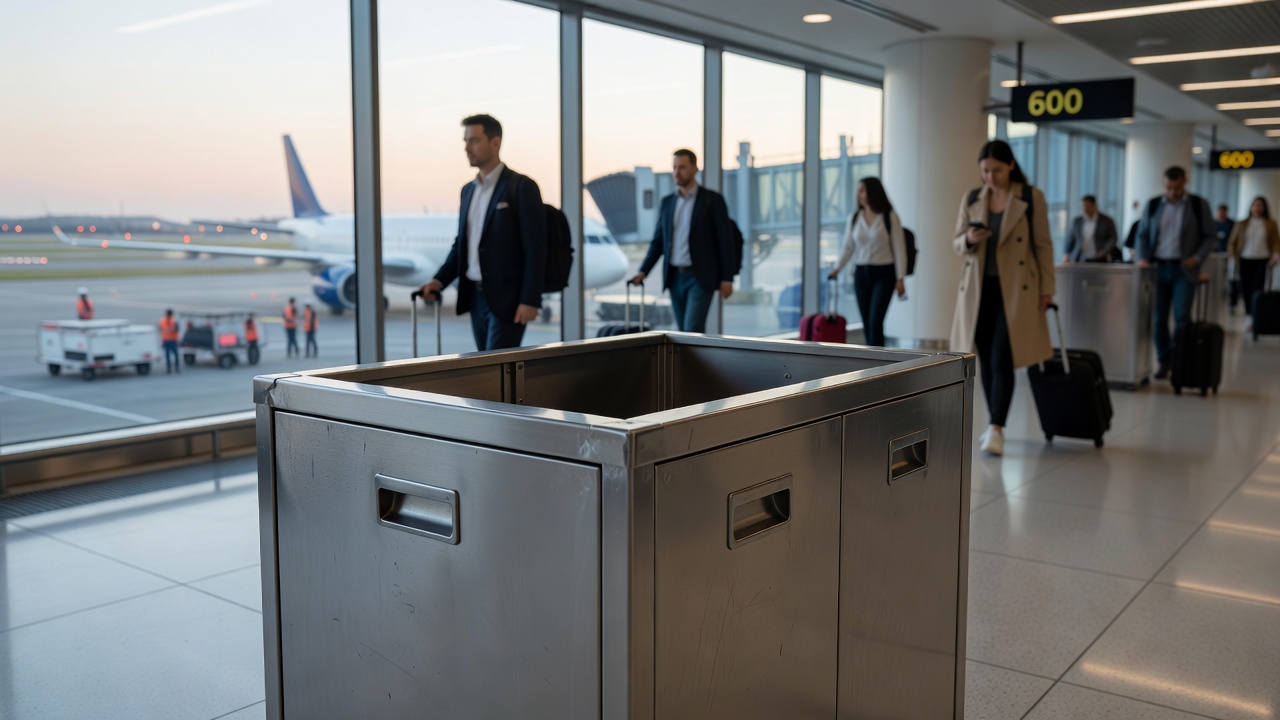
The ultimate arbiter of your bag's legality is the metal sizer bin stationed at the boarding gate. Low-cost carriers (LCCs) and ultra-low-cost carriers (ULCCs) are notorious for aggressively utilizing these sizers as a secondary revenue stream. If your bag cannot easily drop into the metal frame without being forcibly wedged, you will be directed to pay a gate-check fee, which is often substantially higher than checking a bag during initial booking.
Personal Items: The Second Carry-On
Virtually all airlines allow for a "personal item" in addition to your standard carry-on. The definition of a personal item is broad: a purse, laptop bag, briefcases, or a small backpack. The only universal rule is that it must fit completely underneath the seat in front of you. Maximizing the capacity of your personal item is a highly effective strategy for offsetting strict carry-on limits. By placing dense, heavy items (like electronics, chargers, and toiletries) into your under-seat bag, you can keep your primary carry-on well below airline weight thresholds.